One Page Ecommerce Website Guide: Build for Success in 2026
The explosive growth of the one page ecommerce website is transforming how UK businesses sell online in 2026. Customers now expect fast, simple, and mobile-friendly experiences from every online shop.
Is your business ready to keep up? This guide will show you how to plan, design, and launch a high-converting one page ecommerce website that stands out in a crowded marketplace.
Discover proven strategies, expert tips, and the latest tools to help your shop succeed. Learn step-by-step how to create a site that converts visitors and supports your business growth in 2026.
Why One Page Ecommerce Websites Are Winning in 2026
The one page ecommerce website is rapidly becoming the preferred choice for UK businesses in 2026. This approach responds directly to modern consumer expectations for speed, simplicity, and mobile-first experiences. As online competition grows, businesses are rethinking how to present products and drive sales with minimal friction.

Shifting Consumer Behaviours and Expectations
UK shoppers in 2026 expect instant access to products and hassle-free purchasing. Mobile-first shopping dominates, with over half of transactions now completed on smartphones. The rise of micro-moments means consumers often make snap decisions, favouring sites that deliver information and checkout options within seconds.
A recent Statista survey found that 78% of UK shoppers prefer streamlined online experiences. Single page checkouts, a hallmark of the one page ecommerce website, have played a major role in reducing cart abandonment. Fewer clicks and less scrolling keep users engaged, making it easier to convert interest into sales.
Conversion Rate Advantages Over Multi-Page Stores
One page ecommerce websites consistently outperform traditional multi-page stores when it comes to conversion rates. Fewer distractions and a clear, linear shopping journey keep visitors focused on the end goal: completing a purchase.
For example, Shopify data shows that multi-page sites often lose users between product and checkout pages. In contrast, one page ecommerce websites present all essential information, reviews, and buying options in a single flow. According to the Baymard Institute, these sites can achieve up to 24% higher conversion rates. This streamlined approach is particularly effective for brands with a narrow product range or limited-time offers.
SEO and Performance Benefits
A one page ecommerce website offers significant SEO and performance advantages. With fewer pages, load times are faster, directly improving user experience and Core Web Vitals scores. Google has publicly stated its preference for sites that are both quick and mobile-optimised.
The simplified structure also makes it easier for search engines to crawl and index content. Product information, reviews, and checkout details are all accessible from a single URL, boosting relevance and authority. For businesses keen to maximise organic visibility, choosing a platform with robust ecommerce website builder features ensures technical SEO is covered without complexity.
Cost and Maintenance Efficiencies
Building and maintaining a one page ecommerce website is typically more affordable than managing a multi-page store. Fewer pages mean lower development costs, reduced hosting requirements, and easier updates.
Content changes, product launches, or seasonal promotions can be rolled out quickly without the need to coordinate across multiple sections. For small businesses and startups, this efficiency translates to more time and budget for marketing and customer service. A simple site also means fewer technical issues and less risk of outdated content.
Ideal Use Cases for One Page Ecommerce
Not every business needs a sprawling online shop. The one page ecommerce website is ideal for startups, direct-to-consumer brands, product launches, and sellers with a focused catalogue.
Successful UK examples include single product skincare brands and limited-edition merch drops. These businesses benefit from clear storytelling, fast checkouts, and a compelling brand narrative. For companies looking to test new products or enter the market with minimal investment, the one page model offers a smart, agile solution.
Step-by-Step Guide: Building Your One Page Ecommerce Website
Creating a one page ecommerce website might seem daunting, but breaking it into clear steps makes the process manageable and rewarding. Whether you’re launching a new brand or streamlining an existing shop, this guide will take you from first concept to a live, high-converting site.

Step 1: Define Your Goals and Audience
Every successful one page ecommerce website starts with a clear vision. Take the time to clarify your business goals. Are you aiming for rapid sales, brand awareness, or building a loyal customer base?
Identify your target audience. Build customer personas that reflect real UK shoppers. For example, a niche skincare brand targeting Gen Z in the UK will have different visual and messaging needs compared to a craft coffee startup for millennials.
Pinpoint your core product or product range. What is unique about it? What pain points does it solve? Your unique selling proposition should be front and centre throughout your one page ecommerce website.
Knowing what you want to achieve and who you want to reach will guide every decision, from site structure to marketing tactics. This foundation ensures your efforts are focused and your one page ecommerce website stands out in a crowded market.
Step 2: Plan Your Content and Site Structure
Planning content is crucial for an effective one page ecommerce website. Map out all the essential sections your site will need:
- Hero section with a strong headline and image
- Product details and features
- Benefits and value proposition
- Testimonials or reviews
- FAQs to address objections
- Streamlined checkout form
Wireframe your page to visualise the flow. Place persuasive calls-to-action at strategic points. Craft concise, benefit-driven copy that guides visitors towards purchase. Use short paragraphs and bullet points to make information easy to digest.
Think about the order of information. Lead with impact, build trust, then guide users to buy. A well-structured one page ecommerce website keeps users engaged and reduces the chance of them dropping off.
Step 3: Choose the Right Platform and Tools
Selecting the right platform is a pivotal step for your one page ecommerce website. UK businesses often compare Avantiy, Shopify, Wix, Squarespace, GoDaddy, and Duda. Each offers distinct strengths.
| Platform | Ease of Use | Ecommerce Features | Scalability | Support |
|---|---|---|---|---|
| Avantiy | Excellent | Built-in, AI tools | High | UK-based |
| Shopify | Good | Powerful | Very High | 24/7 Global |
| Wix | Good | Basic-Moderate | Medium | UK & Int’l |
| Squarespace | Good | Limited | Medium | Int’l |
| GoDaddy | Basic | Limited | Medium | UK & Int’l |
| Duda | Good | Moderate | High | Int’l |
Consider your technical skills, need for customisation, and growth plans. For rapid setup, look for platforms with drag-and-drop builders and pre-designed one page website templates. Assess payment integration, SEO tools, and local support before deciding.
Avantiy: The Smart Choice for One Page Ecommerce
Avantiy is designed for UK small businesses seeking an all-in-one solution. Its AI-powered drag-and-drop builder enables users to launch a one page ecommerce website in hours, not weeks. No coding is required, and every template is optimised for mobile and conversions.
You get built-in ecommerce functionality, SEO tools, and fast payment integrations with Stripe, PayPal, and Apple Pay. Avantiy also offers personalised UK-based support, making it easy to resolve any issues quickly.
A real-world example: a UK artisan bakery used Avantiy to launch a single product store overnight, attracting local customers and processing payments with no technical hassle. The platform’s intuitive design and seamless integrations make it the go-to for ambitious startups.
Step 4: Design for Conversion and Trust
Design is more than aesthetics. Your one page ecommerce website must inspire trust and guide visitors to action. Start with a clean, mobile-first layout that adapts to any device.
Use high-impact visuals to showcase products. Add trust badges, security icons, and clear return policies. Social proof—like customer reviews and testimonials—should be prominent.
Small design tweaks can make a big difference. For instance, updating button colours for visibility and adding a testimonial slider helped one UK brand increase conversions by 30 percent. Every element should support a smooth path to purchase.
Step 5: Integrate Seamless Checkout and Payment Solutions
A frictionless checkout is essential for your one page ecommerce website. Keep forms short. Only ask for information you truly need. Integrate secure payment gateways trusted by UK consumers, such as Stripe, PayPal, and Apple Pay.
One-click checkout options and autofill features minimise drop-offs. According to industry data, sites with streamlined checkout processes see significantly higher sales completion rates. Always display a clear cart summary and allow easy editing before final payment.
Prioritise security and transparency. Highlight SSL certificates and privacy assurances. The easier and safer it feels to buy, the higher your conversion rates will climb.
Step 6: Launch, Test, and Optimise
Before going live, walk through a pre-launch checklist for your one page ecommerce website:
- Test site speed on mobile and desktop
- Check all payment and checkout functions
- Ensure security protocols are in place
- Set up analytics and conversion tracking
- Confirm legal compliance (GDPR, terms, privacy)
Once live, use A/B testing to refine headlines, CTAs, and product images. Monitor analytics to track where users drop off or convert. Continuously update your content and design based on real user behaviour.
Launching is just the start. Ongoing optimisation ensures your one page ecommerce website remains competitive and continues to grow with your business.
Essential Features for High-Converting One Page Ecommerce Sites
Creating a high-performing one page ecommerce website means focusing on features that drive trust, clarity, and action. Every element should work together to convert visitors quickly, especially in the fast-paced UK market. Let’s explore the must-haves for your single page shop.
Compelling Product Showcases
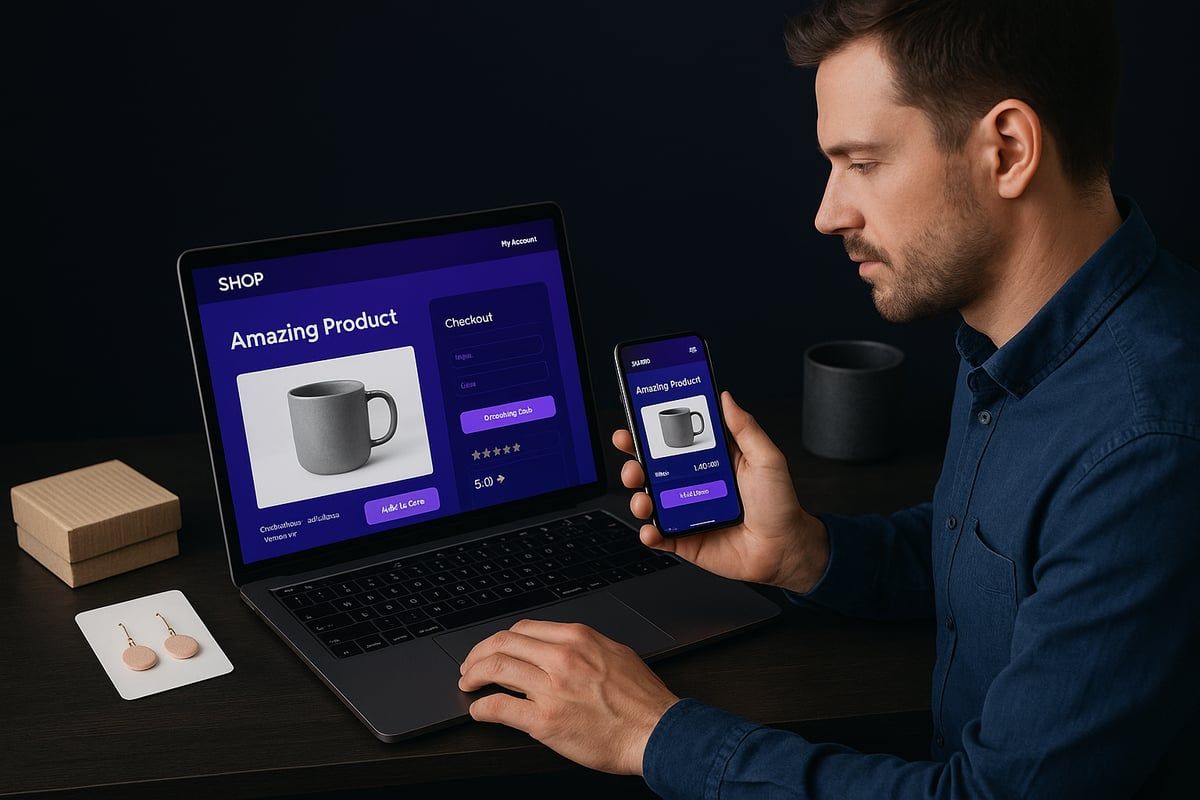
Your one page ecommerce website must present products in the best possible light. Use sharp, high-resolution images to convey detail and quality. Interactive features such as 360° views and video demonstrations help shoppers understand your offer instantly.
- Include zoom functionality for closer inspection.
- Offer colour swatches or size selectors if applicable.
- Highlight key features with concise icons or bullet points.
These elements reduce uncertainty and encourage users to move towards purchase, especially when your catalogue is limited.
Trust-Building Elements
Trust is essential on a one page ecommerce website. Display real customer reviews and testimonials prominently. Add star ratings and, where possible, user-generated photos.
- Use security badges to show your site is safe.
- Clearly state guarantees, returns, and delivery policies.
- Make your contact details easy to find.
A transparent approach reassures UK shoppers, leading to higher conversion rates.
Persuasive Copy and CTAs
Every word on your one page ecommerce website matters. Use benefit-led headlines and concise product descriptions. Avoid jargon, focusing on how your product solves problems or improves lives.
- Place strong, visible calls-to-action at key points.
- Use action verbs: “Buy Now”, “Try Free”, or “Get Yours Today”.
- Repeat your main CTA, but avoid overwhelming visitors.
Well-crafted copy, paired with clear CTAs, guides users smoothly from interest to checkout.
Seamless Checkout Integration
A frictionless checkout is vital for a one page ecommerce website. Keep forms short, requesting only essential information. Enable autofill to speed up the process.
- Add a cart summary popup for quick edits.
- Offer multiple payment options: Stripe, PayPal, Apple Pay.
- Use progress indicators so users know what to expect.
A smooth, single-step checkout can dramatically reduce abandonment and boost sales.
Social Proof and Urgency Triggers
Social proof builds confidence, while urgency encourages action. Add real-time purchase notifications to show activity on your one page ecommerce website. Display low stock alerts or limited-time offers.
- Use countdown timers for special deals.
- Show how many people are viewing or have bought recently.
- Highlight popular or trending products.
These subtle cues can nudge visitors to complete their purchase before missing out.
Mobile and Accessibility Optimisation
Most shoppers now browse and buy on mobile devices. Your one page ecommerce website must be fully responsive, loading quickly and looking sharp on any screen.
- Use large, touch-friendly buttons for easy navigation.
- Choose readable fonts and clear contrasts.
- Ensure compliance with UK accessibility standards (WCAG 2.2).
A mobile-optimised, accessible site widens your audience and meets legal obligations.
Analytics and Tracking Tools
To grow your one page ecommerce website, you need actionable insights. Integrate tools like Google Analytics and Meta Pixel to monitor traffic and conversions.
- Track user journeys to identify drop-off points.
- Run A/B tests on headlines and images to improve performance.
- Use conversion tracking to measure your ROI.
For deeper optimisation, explore SEO tips for ecommerce sites to ensure your one page shop ranks well in search results.
Optimising Your One Page Ecommerce Site for SEO and Performance
Building a high-performing one page ecommerce website is essential for reaching UK shoppers in 2026. To stand out in search, load quickly and convert visitors, you need a focused approach to SEO and performance. Let’s explore the best strategies for making your single page shop shine in competitive search results.

On-Page SEO Best Practices
For your one page ecommerce website, on-page SEO is your foundation. Start with thorough keyword research, targeting both product and transactional intent. Craft unique meta titles and descriptions for your page, using relevant search phrases.
Optimise product images with alt tags and compress them for speed. Use clear, benefit-driven headlines and structured content sections. For example, highlight “UK vegan skincare” in your product details for targeted visibility.
Keep your copy concise, persuasive and relevant to your audience. Internal linking is limited on a single page, so ensure your content flows logically from section to section.
Core Web Vitals and Site Speed
Site speed is a critical ranking factor for any one page ecommerce website. Google rewards pages that load in under two seconds, with data showing a 50% uplift in engagement for fast sites.
Focus on compressing images and using modern file formats like WebP. Limit third-party scripts and use lazy loading for below-the-fold content. Platforms such as Avantiy and Duda offer built-in optimisation tools to help you meet Core Web Vitals benchmarks.
Regularly test your site with PageSpeed Insights and address any issues promptly. Fast-loading pages keep shoppers engaged and reduce bounce rates.
Structured Data and Rich Snippets
Implementing structured data is a powerful way to help search engines understand your one page ecommerce website. Use product schema to mark up prices, reviews and availability. This can earn rich snippets, making your listings more attractive in Google results.
Add FAQ schema for your frequently asked questions section. This improves the chance of your content appearing in People Also Ask boxes. Avantiy and Shopify provide plugins or built-in features to simplify schema integration.
Rich results can boost click-through rates and help your single page stand out from larger competitors.
Mobile SEO and User Experience
With mobile commerce expected to account for 55% of UK transactions in 2025, optimising for mobile is non-negotiable. Your one page ecommerce website must be fully responsive, with touch-friendly buttons and clear navigation.
Choose large, readable fonts and ensure all content is accessible without pinching or zooming. Test your checkout process on various devices for smooth, swift completion.
For more insights on the rise of mobile shopping and its impact on ecommerce, see Mobile commerce to account for 55% of UK transactions in 2025.
Mobile-friendly design not only improves user experience but also strengthens your SEO and conversion rates.
Link Building and Local SEO
To boost your one page ecommerce website’s authority, focus on acquiring relevant backlinks. Get featured in UK directories and local business blogs. Leverage Google Business Profile to enhance local visibility and drive nearby shoppers to your store.
Encourage satisfied customers to leave reviews on Google and other platforms. This builds trust and signals credibility to search engines. Platforms like Avantiy make it easy to integrate review widgets and manage testimonials.
Combine local SEO with social proof for a powerful conversion boost.
Monitoring and Continuous Improvement
Ongoing monitoring is vital for long-term success. Use Google Search Console to track rankings, fix crawl errors and submit sitemaps. Set up analytics to monitor visitor behaviour, drop-off points and conversion rates.
Regularly update your one page ecommerce website with fresh content, new testimonials and product updates. Test changes with A/B experiments to optimise headlines and calls-to-action.
Staying proactive with performance and SEO ensures your site remains competitive, relevant and ready to grow.
Marketing and Growing Your One Page Ecommerce Business
Unlocking growth for your one page ecommerce website in 2026 requires a blend of smart marketing, data-driven tactics, and customer-centric strategies. With competition rising, mastering these areas will ensure your brand stands out, converts, and scales.
Paid Advertising and Retargeting
Paid advertising remains a powerful driver for any one page ecommerce website. Platforms like Google Ads, Meta Ads, and TikTok offer highly targeted options, especially for single product stores.
- Launch retargeting campaigns to win back visitors who didn't buy on their first visit.
- Test different ad creatives to see what resonates best with your target audience.
- Track ROI closely, focusing spend on the channels with highest conversion rates.
Modern sites are now leveraging AI-powered personalization boosts conversion rates by 28% to ensure ads are tailored for each shopper, which can result in more efficient spend and higher returns.
Social Media Integration and Influencer Partnerships
Integrating social media is essential for driving organic and paid traffic to your one page ecommerce website. Embedding Instagram feeds and shoppable posts creates a seamless path from discovery to purchase.
- Partner with UK micro-influencers who share your brand values.
- Feature user-generated content to build authenticity and trust.
- Use social proof from real customers to encourage conversions.
These steps help create buzz and establish your site as a go-to destination in your niche.
Email Marketing and Lead Capture
Email remains a high-ROI channel for a one page ecommerce website. Pop-up forms and lead magnets can quickly build your list, while automated welcome sequences nurture new subscribers.
- Offer discounts or free guides as incentives for sign-ups.
- Segment your audience to send relevant, timely messages.
- Use analytics to optimise subject lines and content for higher open rates.
A well-crafted email campaign can move hesitant visitors closer to purchase and boost repeat sales.
Content Marketing and Blogging
Even with a single product, adding a blog or resource section enhances SEO for your one page ecommerce website. This positions your brand as an authority and brings in organic traffic.
- Write product how-to guides, usage tips, and industry insights.
- Link to helpful resources or customer stories.
- Update content regularly to keep your site fresh for both users and search engines.
This approach increases engagement and drives long-term growth.
Customer Feedback and Community Building
Collecting feedback is vital for continuous improvement. Encourage reviews, run quick polls, and launch loyalty programmes to foster a community around your one page ecommerce website.
- Display testimonials and ratings prominently.
- Respond to customer questions and concerns promptly.
- Use insights from feedback to refine your offer and messaging.
Building a loyal audience leads to more referrals and stronger brand reputation.
Scaling Up: When to Expand Beyond One Page
As your one page ecommerce website grows, you might notice the need for more content or a broader catalogue. Signs to expand include frequent customer requests for more information or new products.
- Plan your transition carefully to maintain existing SEO and customer trust.
- Choose a flexible platform like Avantiy, which allows seamless scaling from one page to multi-page layouts.
- Review Avantiy pricing and plans to ensure your site can grow affordably as your needs change.
By monitoring growth signals and acting proactively, you ensure your ecommerce journey remains smooth and successful.
Platform Comparison: Avantiy vs. Other Website Builders
Choosing the right platform is crucial for your one page ecommerce website success in 2026. Here, we compare Avantiy with popular builders like Wix, Squarespace, Shopify, GoDaddy, and Duda, focusing on what matters most to UK small businesses.
Ease of Use and Speed to Launch
For a one page ecommerce website, speed and simplicity are essential. Avantiy stands out with its intuitive AI-powered drag-and-drop editor, allowing you to launch a site within hours. Platforms like Wix and Squarespace also offer visual editors, but Avantiy’s setup is tailored for rapid single-page builds, especially for UK businesses.
Shopify and GoDaddy provide guided setups but may involve more steps for customisation. Duda is user-friendly but less focused on ecommerce. If you want to get online fast with minimal fuss, Avantiy is a smart choice.
Built-In Ecommerce and Payment Features
Your one page ecommerce website needs seamless product management and payment solutions. Avantiy includes built-in ecommerce features, secure checkout, and native integrations with Stripe, PayPal, and Apple Pay. This makes transactions easy for both you and your customers.
Shopify excels with advanced ecommerce tools, while Wix and Squarespace cover the basics well. GoDaddy’s offerings are improving, and Duda suits service businesses more than product sales. Avantiy’s all-in-one approach is ideal for streamlined single-product shops.
SEO, Performance, and Hosting
SEO and fast load times are vital for any one page ecommerce website. Avantiy delivers excellent Core Web Vitals, mobile optimisation, and secure UK-based hosting. Its site structure is designed for Google to crawl easily, improving your ranking potential.
Shopify and Squarespace also focus on SEO, but can slow down with add-ons. Wix has improved performance, while GoDaddy and Duda offer reliable hosting but fewer advanced SEO tools. Avantiy’s speed and built-in optimisation give UK merchants a clear edge.
Customisation and Integrations
Customising your one page ecommerce website is straightforward with Avantiy’s templates and widgets. Add booking forms, reviews, or CRM tools without coding, supporting a tailored customer journey.
Wix and Squarespace offer broad template libraries and app integrations. Shopify’s app ecosystem is vast but can become complex. GoDaddy provides simplicity, while Duda is best for basic integrations. Avantiy balances flexibility and ease of use, making it suitable for single-page shops.
Pricing and Support
Cost and support matter for every one page ecommerce website owner. Avantiy offers transparent pricing and a free plan, with UK-based support and onboarding. Shopify and Squarespace are higher priced, especially for ecommerce. Wix and GoDaddy are affordable but may charge for key features. Duda’s pricing is competitive for agencies but less so for solo sellers.
Best Fit Scenarios
Avantiy is ideal for UK startups, single-product businesses, or quick launches. Shopify suits larger catalogues, Wix and Squarespace are best for creatives, GoDaddy for simple shops, and Duda for agencies.
Real-world example: A UK skincare brand launched a one page ecommerce website with Avantiy and saw faster setup and better conversion rates than with previous platforms.
As you’ve seen throughout this guide, building a one page ecommerce website isn’t just about keeping things simple—it’s about creating a seamless, high-converting experience that meets the expectations of today’s UK shoppers. With Avantiy’s intuitive drag and drop tools, built in ecommerce features, and AI powered support, you’re equipped to launch quickly and confidently, without any coding headaches. If you’re ready to put these strategies into action and start selling online with impact, there’s no better time to take the next step.
Start building your new website today
No credit of debit card required start building today